As AI systems move from single-prompt generation to autonomous, long-running workflows, developers face new architectural challenges. In this shift, two terms appear frequently: Agentic AI and AI Orchestration. They are often used in similar contexts, but they describe distinct layers of the software stack.
Agentic AI and AI Orchestration both address problems of applying AI to complex tasks, but they operate at different scales. Understanding this distinction is essential for building systems that are both scalable and capable of operating without constant supervision.
To visualize the relationship, imagine a nested diagram:
.png)
- The LLM: The raw inference engine (e.g., Claude 3.5 Sonnet, GPT-4) sits at the end. It possesses intelligence but lacks agency.
- Agentic AI: The agentic layer uses the LLM. This gives the model a "body" with access to tools, memory, and a reasoning process.
- AI Orchestration: The orchestration layer manages the agent. This infrastructure manages the agent's lifecycle, resources, and boundaries.
What Is Agentic AI?
Agentic AI is the system or process that uses an LLM to decide on actions and invoke tools to achieve a goal. Agentic systems move beyond simple "chat" by introducing a loop: Perceive → Reason → Act → Observe Result → Repeat.
Some of the key capabilities of Agentic AI include:
- Tool Use: Invoking specific capabilities like running terminal commands, browsing documentation, or editing files.
- Autonomy: The ability to execute multiple steps without human intervention.
- State Management: Maintaining context over the course of a specific task.
When building the agentic layer, engineers focus on execution. For example, answering the questions: How does the model know which file to edit? How can the agent recover if a unit test fails? What context from the codebase needs to be in the prompt window?
For example, remediating CVEs at Scale relies heavily on Agentic AI. The agent explores a repository, verifies a CVE via build-and-scan, applies a fix (dependency upgrade or code change), runs tests, then re-scans and opens a PR. This workflow can be relatively self-contained for a single CVE given access to the right tools. But when many such processes run in parallel—triage, monitoring, retries, human review queues, and coordination across teams—that’s where AI orchestration becomes essential.
What Is AI Orchestration?
AI Orchestration operates at a higher level of abstraction. It is the infrastructure layer governing which agents get executed for which tasks, and manages logistics like permissions, and connectivity. Orchestration becomes critical when scaling from one agent on a laptop to hundreds of concurrent agents in the cloud.
The key capabilities of AI Orchestration are more high-level:
- Governance & Sandboxing: Ensuring an agent execution (e.g.,
rm -rf /) remains contained within a disposable Docker container and cannot touch production secrets. - Resource Management: Controlling API rate limits, compute resources, and costs across a fleet of agents.
- Routing: Assigning specific sub-tasks to the correct agent or model.
When building the orchestration layer, engineers focus on stability and safety. For example, engineers might answer questions like: How do we isolate the agent's runtime so it doesn't leak credentials? How do we scale to 1,000 concurrent jobs without hitting API rate limits? How do we handle a "zombie" agent that gets stuck in an infinite loop?
To give one example, in the blog on COBOL to Java refactoring, we discuss how the OpenHands large codebase SDK can be used to break down large codebase refactors and assign subtasks, and how cloud infrastructure can be used to appropriately sandbox agents working on each task.
Orchestration problems become especially pertinent as businesses look to scale their AI integrated systems. It’s akin to how data pipelines are needed to scale data stores or infrastructure-as-code solutions are needed to scale microservice architecture.
Comparing the Tooling
The difference between AI Orchestration and Agentic AI becomes clearest when looking at the tech stack.
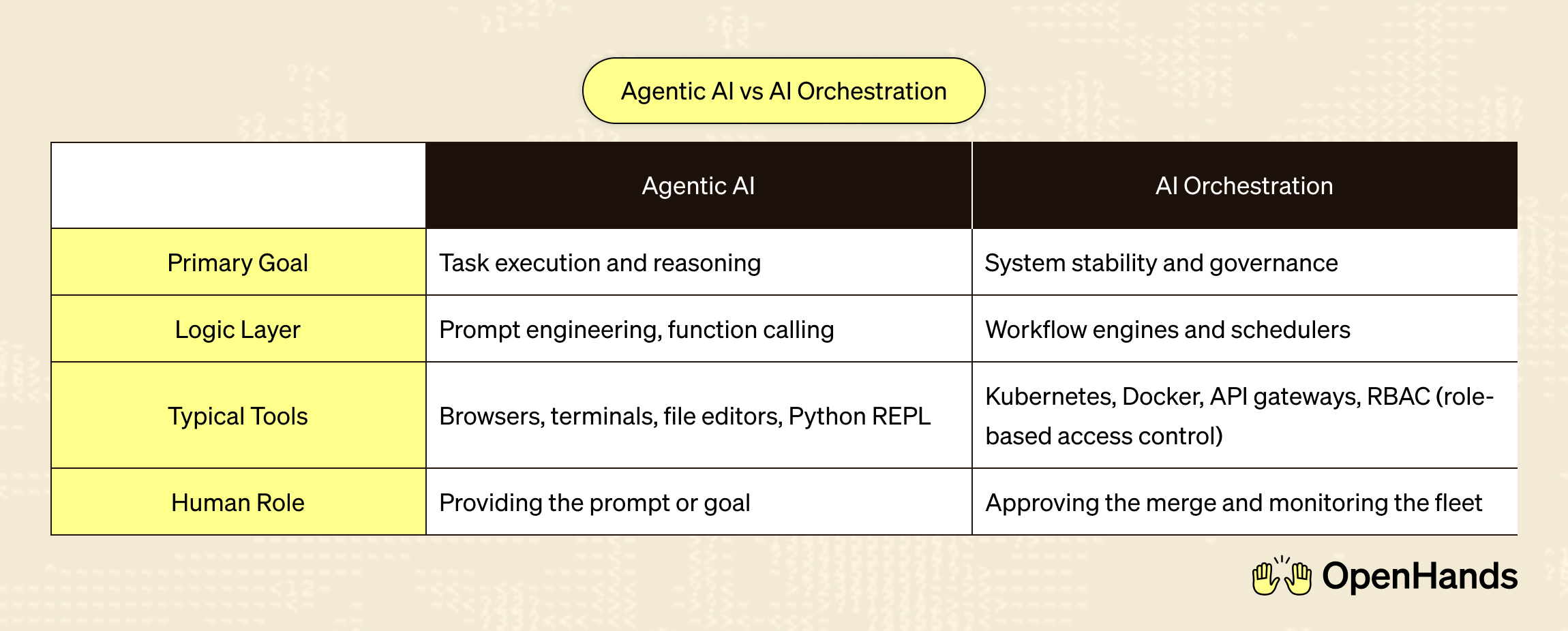
How Agentic AI and Orchestration Work Together
Orchestration provides the structure within which agentic systems can operate safely. Agentic AI, in turn, provides the intelligence that makes orchestration worthwhile. In the "Outer Loop" of software development, where AI works asynchronously in the background, these two layers must coexist.
Pure Agentic AI can be volatile. Without orchestration, an autonomous agent runs the risk of being a loose cannon. Orchestration provides the "sandbox"—usually a containerized environment—that allows the agent to be creative and autonomous without risking the integrity of the host system.
Orchestration also enables scale. Some agents perform small, atomic tasks. Others perform massive, long-running tasks like major codebase refactors. As the duration and complexity of tasks increase, orchestration is required to handle timeouts and ensure reliability.
As task size and duration increase, the importance of orchestration grows. Small agents can often operate without it, but large systems cannot.
What is OpenHands?
OpenHands is primarily an Agentic AI system, with a strong focus on autonomous coding agents. Our core strength lies in enabling LLM-driven agents to perform complex software engineering tasks: exploring repositories, modifying code, running tests, and iterating until objectives are met.
OpenHands also includes light orchestration capabilities, such as tooling to run agents programmatically and integrate them into larger workflows. However, we are not positioned as a full orchestration platform. Instead, the product excels at the agent layer—where decision-making, planning, tool use, and execution happen.
That said, for companies that are focused on implementing AI strictly for engineering, then OpenHands is a strong all-in-one solution. OpenHands provides the high-level agentic intelligence needed to solve complex coding problems, wrapped in the necessary orchestration logic to run those agents safely on your codebase. In a nutshell, it provides agent autonomy while remaining composable within larger orchestrated environments.



Get useful insights in our blog
Insights and updates from the OpenHands team
Sign up for our newsletter for updates, events, and community insights.
Thank you for your submission!
OpenHands is the foundation for secure, transparent, model-agnostic coding agents - empowering every software team to build faster with full control.



%201.svg)